|
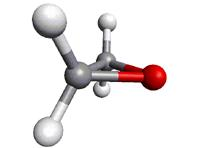
E-2,3-dideuterooxirane is one of three dideuterooxirane isotopomers.
The outdated name trans-2,3-dideuterooxirane can still be found occasionally.
The transition frequencies were summarized in
(1) Z. Chen, S. Albert, K. Keppler, G. Wichmann, M. Quack,
V. Schurig, and O. Trapp,
2026, Phys. Chem. Chem. Phys. 28, 751.
Most of the extensive measurements between 64 and 502 GHz
are from this work. A small number of less accurate
transition frequencies up to 61 GHz were taken
from
(2) C. Hirose,
1974, Bull. Chem. Soc. Japan 47, 1311.
These data were retained in the fit only for completeness reasons.
The calculation should be sufficient for all observational
purposes. Calculated frequencies with uncertainties exceeding
0.1 MHz should be viewed with some caution.
ortho states of the molecule are described by
Ka + Kc being odd,
whereas para states have Ka +
Kc even with the ratio being 7 : 5.
The partition function takes into account the ground
vibrational state only because the molecule resides in
somewhat colder regions. Excited vibrational states are quite
high; their effect is still modest at room temperature.
The dipole moment was assumed to agree with that of the
main isotopolog published by
(3) G. L. Cunningham Jr., A. W. Boyd, R. J. Myers,
W. D. Gwinn, and W. I. Le Van,
1951, J. Chem. Phys. 19, 676 ;
with its value slightly increased by 0.02 D due
to an updated reference value for OCS as outlined
in
(4) H. S. P. Müller, J. C. Guillemin, F. Lewen,
and S. Schlemmer,
2022, J. Mol. Spectrosc. 384, Art. No. 111584.
|